
Louisiana Child Custody Laws: What Every Parent Needs to Know

Louisiana custody law starts from a default that both parents share joint custody. In many cases, the court also designates one parent as the domiciliary parent, giving that parent primary decision-making authority unless otherwise provided in the custody order. That domiciliary parent designation is usually the most consequential call a Louisiana court makes in a custody case — far more consequential than the “joint custody” label itself.
This article covers how Louisiana actually decides custody under Civil Code Articles 131 through 137 and the relevant Revised Statutes: the joint-custody default, the domiciliary parent designation, the 14 best-interest factors a judge weighs, what visitation looks like for the parent without primary custody, how prior violence or abuse changes the analysis, and the rules for moving with your child.
What does “child custody” actually mean under Louisiana law?
Louisiana is a civil law state, meaning its custody framework is built on a codified statutory structure rather than the common-law tradition used in the other 49 states. That matters because terms like “joint custody” and “domiciliary parent” carry specific statutory definitions in Louisiana that don’t always match how the same words are used elsewhere.
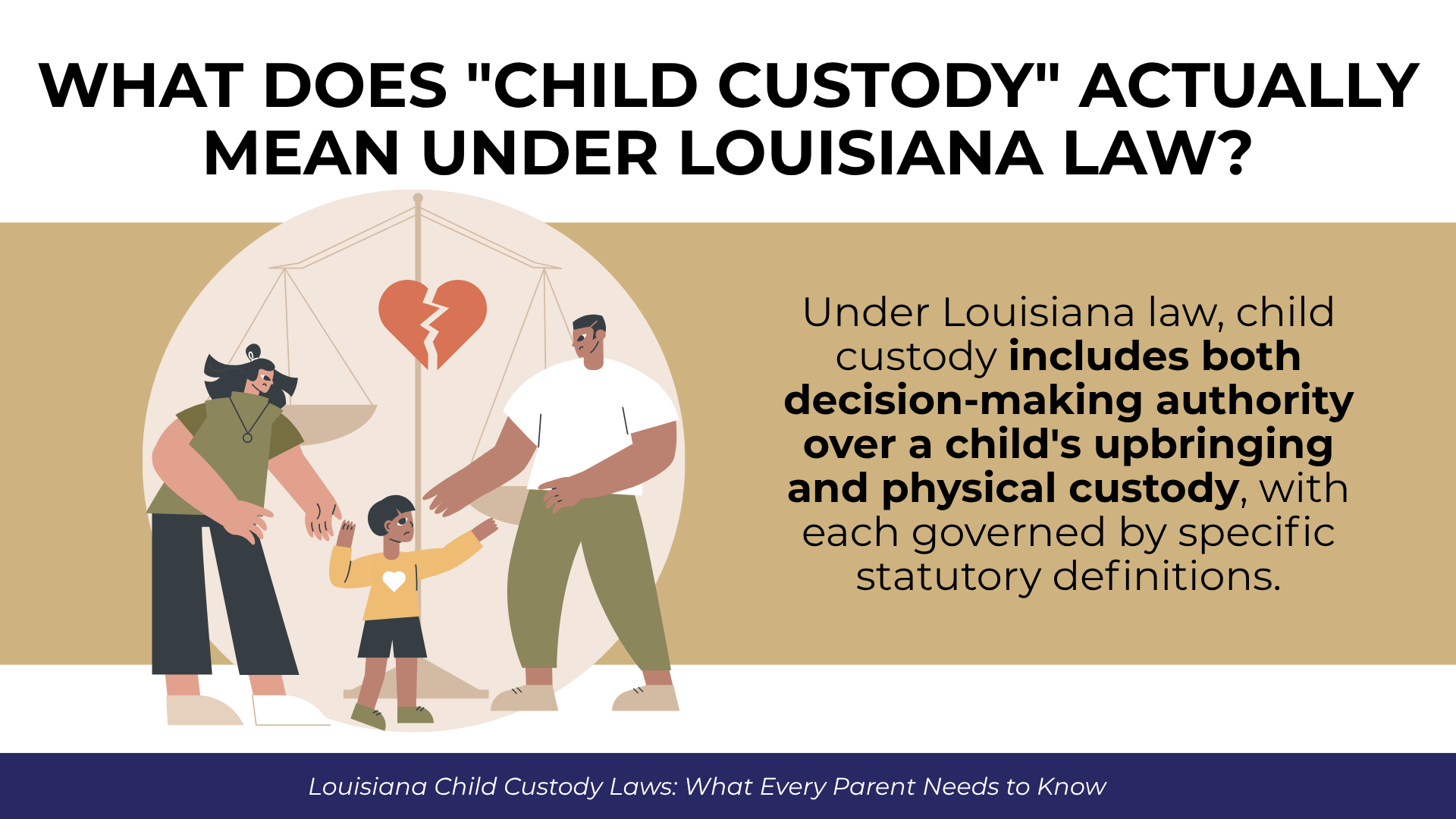
Custody in Louisiana operates on two layers. The first is legal authority — the power to make major decisions about the child’s life (medical care, education, religion, where the child lives). The second is physical custody — where the child actually spends time. A custody order has to address both, and Louisiana statutes treat them as separate questions even when they overlap in practice.
This vocabulary matters because the questions you need to ask — and the questions a court will answer — are framed in these terms.
Does Louisiana favor joint custody, or can one parent get sole custody?
Louisiana law presumes joint custody. Under Civil Code Article 132, if parents reach an agreement on custody, the court honors it unless the agreement is contrary to the child’s best interest. If there’s no agreement, the court awards joint custody by default.
Sole custody is the statutory exception. To obtain sole custody under Article 132, a parent has to prove by clear and convincing evidence that sole custody serves the child’s best interest. That’s a higher evidentiary standard than the ordinary preponderance-of-the-evidence test, and Louisiana courts apply it strictly. Most contested custody cases in Louisiana end with joint custody. The actual fight is over the terms of that joint custody rather than whether it will be awarded.
One critical clarification: joint custody in Louisiana does not mean equal 50/50 physical time. Revised Statute 9:335 says physical custody should be shared equally “to the extent it is feasible and in the best interest of the child.” That’s an aspiration, not a mandate. In most joint custody arrangements, one parent has the child the majority of the time and the other has scheduled physical custody on a defined rotation.

If we share joint custody, who has the real authority — what is a “domiciliary parent”?
The domiciliary parent designation under R.S. 9:335 is the single most important issue in most Louisiana joint custody cases. Many parents have no idea it exists when they start a custody dispute.
When a Louisiana court issues a joint custody decree, R.S. 9:335 requires the court to also issue a joint custody implementation order without good cause to do otherwise. That implementation order does three things: allocates time periods during which each parent has physical custody, includes an emergency or disaster contingency provision, and allocates the legal authority and responsibility of the parents.
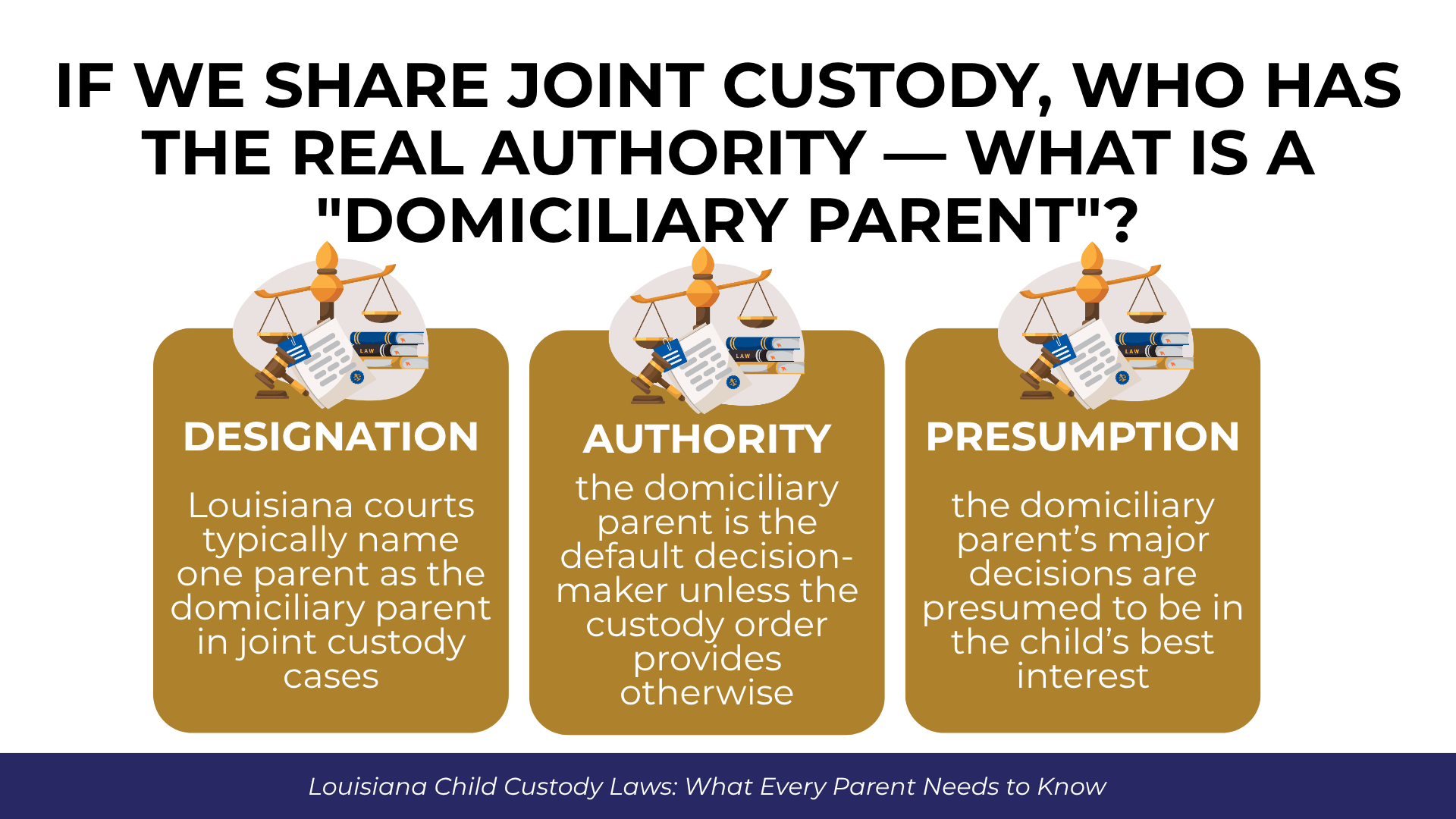
Within that allocation of legal authority, the court designates one parent as the domiciliary parent. The statutory consequences:
- The custody order allocates physical custody between the parents while also identifying which parent will exercise domiciliary authority.
- The domiciliary parent has authority to make all decisions affecting the child unless the implementation order specifies otherwise.
- All major decisions made by the domiciliary parent are presumed to be in the child’s best interest. The other parent can challenge those decisions in court, but starts from a position where the presumption runs against them.
That third point is what gives the designation its weight. The domiciliary parent is the parent the law treats as the default decision-maker, with a statutory presumption attached. Disputes over schooling, religious upbringing, extracurriculars, and medical care all begin from the assumption that the domiciliary parent is making the right call.
That’s why custody negotiations and trials in Louisiana so often turn on the domiciliary parent designation. The “joint custody” label is largely settled by statute. What’s actually being fought over is which parent gets the practical authority that comes with domiciliary status.
What does a Louisiana judge consider when deciding custody?
Civil Code Article 134 lists 14 best-interest factors a court must consider when determining custody. The factors do not have equal weight — the statute explicitly elevates one of them as the primary consideration.
The primary factor (Art. 134(A)(1)): the potential for the child to be abused, as defined by Children’s Code Article 603. This is the first factor listed in Article 134 and the only one the statute identifies as “the primary consideration.” Because abuse risk is designated as the primary consideration under Article 134, courts take credible evidence of abuse extremely seriously.
The other 13 factors, at Art. 134(A)(2) through (A)(14):
(2) The love, affection, and emotional ties between each party and the child.
(3) The capacity and disposition of each party to give love, affection, spiritual guidance, education, and rearing.
(4) The capacity to provide food, clothing, medical care, and material needs.
(5) The length of time the child has lived in a stable, adequate environment, and the desirability of maintaining continuity.
(6) The permanence of the existing or proposed family unit.
(7) The moral fitness of each party, as it affects the welfare of the child.
(8) Any history of substance abuse, violence, or criminal activity.
(9) The mental and physical health of each party.
(10) The home, school, and community history of the child.
(11) The reasonable preference of the child, if the court deems the child old enough to express one.
(12) The willingness of each party to facilitate a close and continuing relationship between the child and the other parent.
(13) The distance between the parties’ residences.
(14) The responsibility for the care and rearing of the child previously exercised by each party.
A few of these carry disproportionate practical weight in contested cases:
- Continuity of environment (factor 5). Courts heavily favor stability. The parent who has been the primary caretaker, in a stable home, with the child in an established school and community, starts the analysis with a meaningful advantage.
- Prior caretaking (factor 14). Related to continuity. Who has historically handled doctor’s appointments, school events, and daily routines? The court looks at the lived reality of the prior arrangement.
- Willingness to facilitate the other parent’s relationship (factor 12). A parent who actively obstructs the other parent’s relationship with the child can lose significant ground here. Article 134(A)(12) contains an important exception. A parent is not penalized for raising reasonable safety concerns when there is “objectively substantial evidence of specific abusive, reckless, or illegal conduct” by the other parent.
- Substance abuse, violence, criminal activity (factor 8). History matters more than isolated incidents. An old conviction with no pattern carries less weight than recent or repeated conduct. A serious history triggers separate statutory consequences (covered below).
- Mental and physical health (factor 9) contains its own exception. Evidence that an abused parent suffers from the effects of past abuse by the other parent shall not be grounds for denying that parent custody.
The child’s stated preference (factor 11) is given weight only when the court finds the child mature enough to express one. There is no fixed statutory age.

What will my actual custody and visitation schedule look like once a judge orders it?
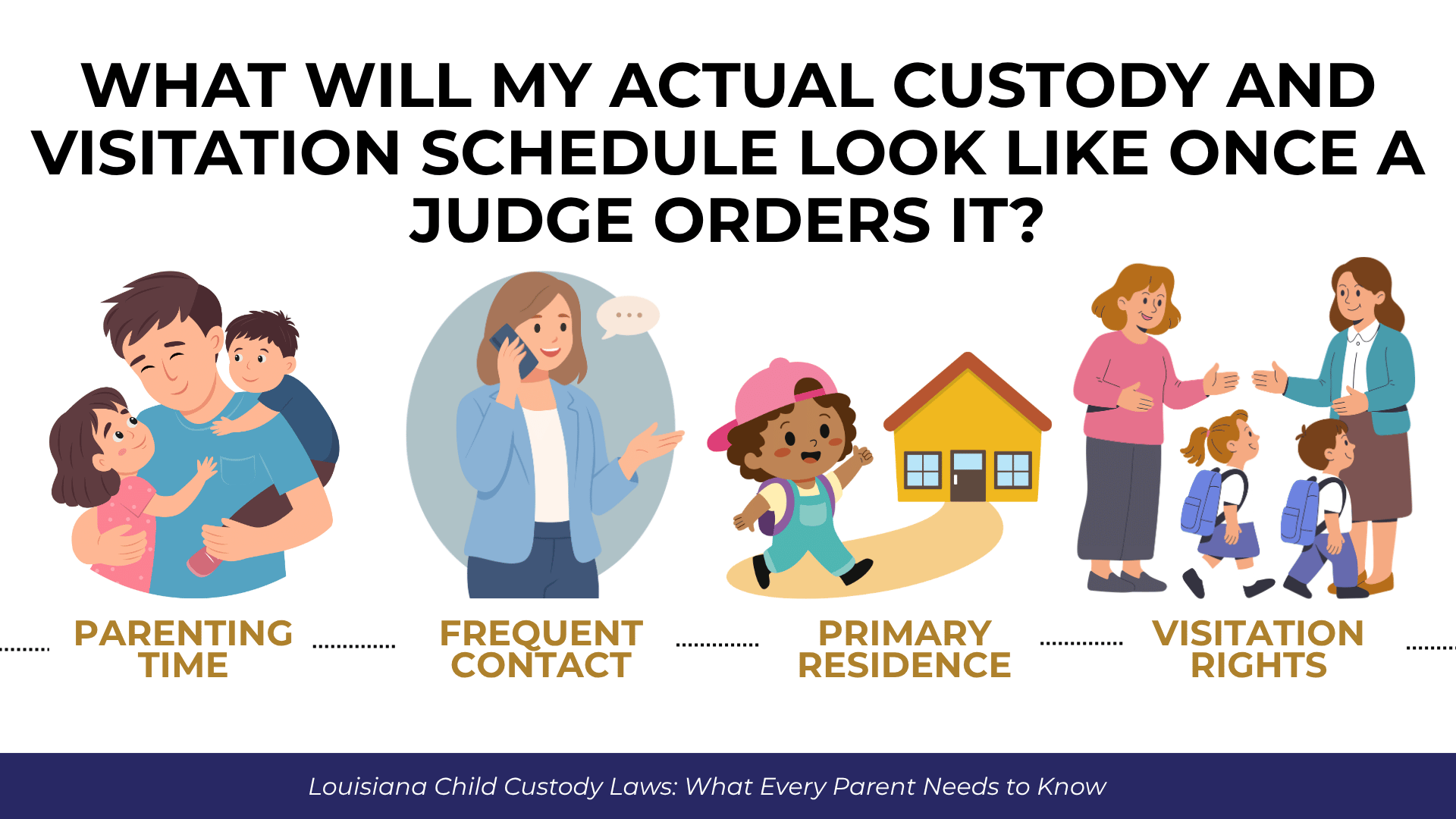
Under R.S. 9:335, the joint custody implementation order allocates physical custody time between the parents. The statutory standard is that the order must assure the child of “frequent and continuing contact with both parents.” Equal time is encouraged where feasible and in the child’s best interest. The more common outcome is one parent having the majority of physical custody — with the domiciliary parent’s home as the child’s primary residence — and the other having defined visitation on a regular rotation. Alternating weekends, midweek visits, holidays, and extended summer schedules are typical building blocks. Every implementation order is structured around the specific family.
A parent not granted joint custody — the rare case where sole custody is awarded — is still entitled to visitation. Under Civil Code Article 136(A), a parent not granted custody or joint custody is entitled to reasonable visitation rights unless the court finds, after a hearing, that visitation would not be in the child’s best interest. That entitlement is statutory; denying visitation entirely requires an affirmative finding by the court.
R.S. 9:335 also requires every implementation order to include an emergency-evacuation provision. The parties must engage in continuous communication regarding the safe evacuation, location, and interim custody of the child during a state or federally declared emergency or disaster.
How do past arrests, abuse allegations, or substance use affect my custody case?
Louisiana treats family violence and abuse as a separate category of analysis, with its own statutory framework distinct from the ordinary 14-factor test. Article 134(B) directs the court, in any case involving a history of family violence or domestic abuse, to determine custody and visitation under R.S. 9:341 and R.S. 9:364 rather than the ordinary best-interest analysis.
What counts as a “history of family violence.” The phrase has a specific statutory definition. Under Article 134(B), a court can find a history of family violence only if it finds either (a) one incident of family violence that resulted in serious bodily injury, or (b) more than one incident of family violence. A single low-level incident without serious bodily injury does not, on its own, meet the statutory threshold.
“Family violence” itself is defined broadly in R.S. 9:362 to include physical or sexual abuse and most offenses against the person under Louisiana’s Criminal Code, committed by one parent against the other parent or against any of the children. Reasonable acts of self-defense are excluded.
The presumption. Where a history of family violence does exist, R.S. 9:364 creates a presumption that the perpetrating parent shall not be awarded sole or joint custody. The presumption can be overcome only if the court finds, by a preponderance of the evidence, all three of the following:
- The perpetrating parent has successfully completed a court-monitored domestic abuse intervention program after the last instance of abuse. R.S. 9:362 defines such a program as a minimum of 26 in-person sessions following a model designed for domestic abuse perpetrators.
- The perpetrating parent is not abusing alcohol or using illegal substances.
- The best interest of the child requires the perpetrating parent’s participation as a custodial parent because of the other parent’s absence, mental illness, substance abuse, or other circumstance negatively affecting the child.
All three elements have to be met. Completing a program alone is insufficient.
Supervised visitation. Under R.S. 9:341(A), when the court finds by a preponderance of the evidence that a parent has subjected a child to family violence or domestic abuse, only supervised visitation is permitted. That parent must then prove at a contradictory hearing both successful completion of an intervention program and that visitation would be in the child’s best interest.
Sexual abuse triggers stricter standards at both ends. Under R.S. 9:341(B), where the court finds by clear and convincing evidence that a parent has subjected a child to sexual abuse, the court must prohibit all visitation and contact. That clear and convincing standard is a higher threshold than the preponderance standard governing general family violence. The prohibition stays in place until the abusing parent proves, at a contradictory hearing, successful completion of a treatment program designed for sexual abusers. The abusing parent bears all costs of supervision.
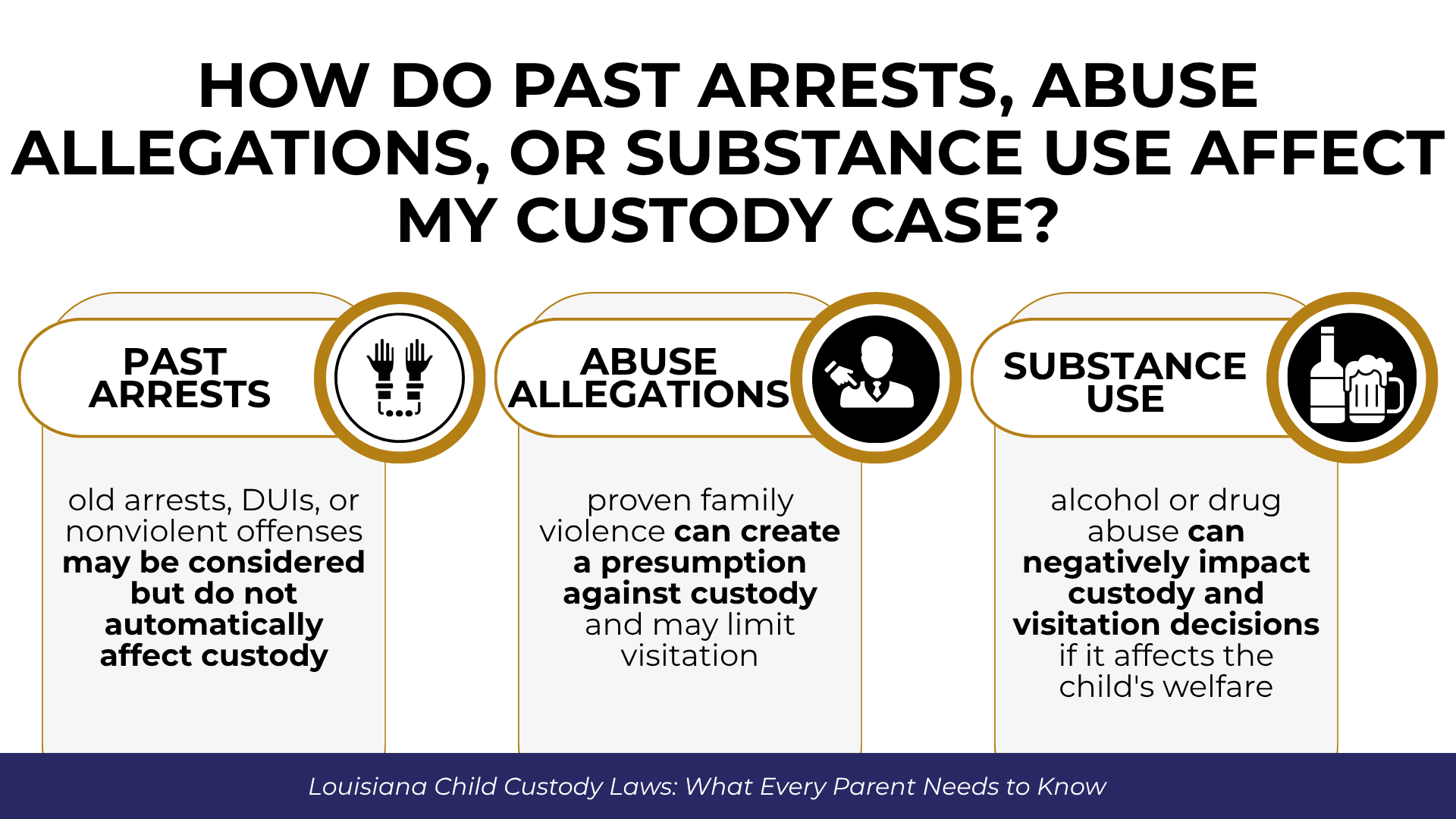
Calibration. Even where conduct does not trigger the statutory family violence presumption, it may still be considered by the court under the broader best-interest analysis. The statutory framework is targeted at documented patterns of violence or abuse against family members. That said, factor 8 of the ordinary best-interest analysis (history of substance abuse, violence, or criminal activity) still applies. Older conduct is not irrelevant — it just does not carry the statutory presumption.
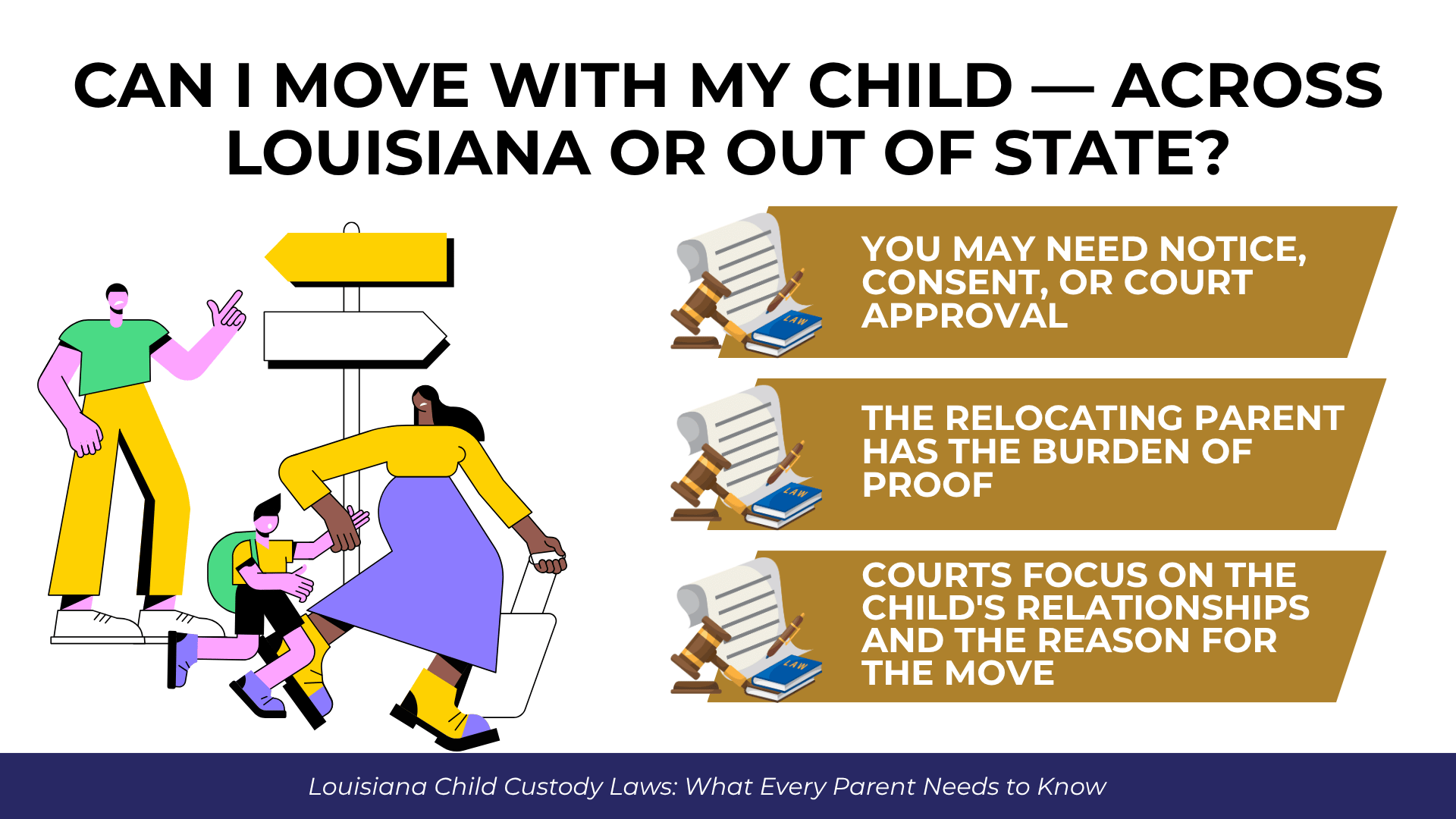
Can I move with my child — across Louisiana or out of state?
Louisiana has a dedicated relocation statute that controls whether and how a parent can change a child’s principal residence. The rules are codified beginning at R.S. 9:355.1.
What counts as relocation. Under R.S. 9:355.1, a relocation is a change in the principal residence of a child for 60 days or more — temporary absences do not count.
When the statute applies. R.S. 9:355.2 sets the triggers. The relocation statute applies when:
- The proposed move is to any location outside Louisiana, regardless of distance, or
- The proposed move is to a location within Louisiana that is more than 75 miles from either the other parent’s domicile (where there is no existing custody order) or the child’s principal residence at the time of the most recent custody decree.
A short move within the same metro area does not trigger the statute. A move from Baton Rouge to Shreveport does.
Who can propose. Under R.S. 9:355.3, only certain parties are authorized to propose a relocation: a sole custodian, a domiciliary parent in a joint custody arrangement, a parent sharing equal physical custody, a parent sharing equal parental authority, or the natural tutor of a child born outside marriage. A parent who is not the domiciliary parent generally cannot propose relocating the child.
Notice requirement. R.S. 9:355.4 requires the parent proposing relocation to give written notice to every person recognized as a parent and any other person awarded custody or visitation under the existing order. If the parents share equal physical custody, the relocating parent must also obtain either court authorization (after a contradictory hearing) or the express written consent of the other parent before moving.
Burden of proof. Under R.S. 9:355.10, the parent proposing relocation carries the burden of proving that the relocation is (a) made in good faith and (b) in the best interest of the child. Both elements must be proved.
The factors. R.S. 9:355.14 lists 12 factors the court considers when relocation is contested:
- The nature, quality, extent, and duration of the child’s relationship with the relocating parent, the non-relocating parent, siblings, and other significant people.
- The age, developmental stage, and needs of the child, and the likely impact of relocation on the child’s development.
- The feasibility of preserving the child’s relationship with the non-relocating parent through suitable custody or visitation arrangements, considering logistics and finances.
- The child’s views about the proposed relocation, considering age and maturity.
- Any pattern of conduct by either parent to promote or thwart the child’s relationship with the other parent.
- How relocation will affect the general quality of life for the child — financially, emotionally, educationally.
- The reasons of each parent for seeking or opposing relocation.
- Each parent’s current employment and economic circumstances and how relocation may affect the child.
- Whether the objecting parent has fulfilled financial obligations to the relocating parent — child support, spousal support, and community property obligations.
- The feasibility of the objecting parent also relocating.
- Any history of substance abuse, harassment, or violence by either parent.
- Any other factors affecting the child’s best interest.
The court is prohibited by statute from considering whether the relocating parent might move without the child if relocation is denied, or whether the objecting parent might also move if relocation is permitted.
The factors that move judges most in contested relocation cases are typically factor 1, factor 3, and factor 7. Factor 1 looks at the child’s existing relationship with the non-relocating parent. Factor 3 examines whether that relationship can realistically be preserved long-distance. Factor 7 considers the reason for the move — a verified job offer, family support, or significant economic opportunity is treated very differently than a relocation that appears designed to put distance between the child and the other parent.
Common Louisiana Custody Myths
Myth #1: Mothers automatically get custody.
Reality: Louisiana law does not favor mothers over fathers. Courts are required to make custody decisions based on the child’s best interests, not the parent’s gender.
Myth #2: Joint custody means 50/50 custody.
Reality: Joint custody does not necessarily mean equal parenting time. In Louisiana, joint custody refers to shared parental authority. Parenting time can be equal, but it often is not.
Myth #3: My child gets to choose where they live when they turn 12.
Reality: There is no magic age in Louisiana where a child gets to decide custody. A judge may consider a child’s preference if the child is mature enough, but the child’s wishes are only one factor among many.
Myth #4: The parent who makes more money has the advantage.
Reality: Custody is not awarded based on income. Judges focus on stability, involvement, parenting ability, and what arrangement is in the child’s best interests.
Myth #5: If my child says they don’t want to visit the other parent, visitation automatically stops.
Reality: Parents are generally expected to follow court orders unless the court modifies them. A child’s reluctance to visit is a serious issue that should be addressed, but it does not automatically eliminate the other parent’s rights.
Myth #6: The parent who files first has an advantage.
Reality: Filing first may allow a parent to present their case first, but it does not give them a legal advantage in the custody determination itself.
Myth #7: Courts expect perfect parents.
Reality: Courts understand that nobody is perfect. Judges are looking for parents who are stable, involved, responsible, and focused on their child’s well-being.
Myth #8: A parent can move wherever they want with the child after a custody judgment is signed.
Reality: Louisiana has specific relocation laws that may require notice to the other parent and, in some cases, court approval before a move can occur.
Where this leaves you
Louisiana custody rests on several key pieces. The joint custody default sets the starting point. The domiciliary parent designation carries the practical authority most parents are actually fighting over. The 14-factor best-interest analysis weights abuse risk as the primary consideration. A separate family violence framework imposes a rebuttable presumption against the abusive parent. And a relocation statute takes any move out of state or more than 75 miles within state out of either parent’s unilateral control.
If you’re weighing a custody dispute, evaluating a proposed agreement, or trying to understand where you stand under Louisiana law, four questions actually matter. Which parent will be designated domiciliary. How the implementation order allocates decision-making and physical time. Which best-interest factors cut in your favor. And whether any of the family violence or relocation provisions apply to your situation.
At The Law Office of Stephen C. Gaubert, we represent Louisiana parents, we represent Louisiana parents in custody, divorce, and relocation matters under the framework above. To discuss how these rules apply to your case, contact our office to schedule a consultation.